Tuesday, September 17, 2013

Combinations

Hello, my name is Jazztyn Ramos. I will be summarizing our lesson on Combinations.
We began our lesson by learning a new formula for Combinations and learning how we are going to be able to tell the differences in a question whether we use Combination or Permutation. 

Combinations: A combination is an unordered collection of elements.

We must be able to learn the differences between a Permutation and a Combination. One way we are able to learn this is by looking at a question and if we are able to see the words:

  • Arranged: This will present a Permutation question
  • Select/Choose: This will present a Combination question
In the booklet we are given 2 questions, 1 is giving us a Permutation question while the other gives us a Combination question.

1. How many ways can 5 books be arranged on a shelf?
 (This is a Permutation question because of the word Arranged)

We solve this question the way we would normally using Permutation:
                               5! = 120

2. How many ways can you select two books to read on your holiday if there are 5 to choose from?
(This is now a Combination question because of the word Select)

 Now in this question we are introduced to our first Combination question, this will give us the opportunity to use our new formula which is:

Combinations Formula

  1. r will represent the number of books we are choosing: 2
  2. n will represent the total number of books: 5
  3. Now we plug it in to the formula:
                    nCr = 5C2 = 5!/2!(5-2)!
                                                       = 5!/2!3!
                                     = 20/2
                                     = 10

With a Permutation, we select and order the elements. With a Combination we only select the elements.
* WE MUST USE THE FORMULA FOR A COMBINATION, NOT THE DASH METHOD

On Example 4, its asks us to evaluate the following:

a) 7C5 = 7!/5!(7-5)! = 42/2 = 21
b) 7C2 = 7!/2!(7-2)! = 42/2 = 21

This Example introduces us to the formula: nCx = nCy
(This shows us that if there is the same number that represents "n" as long as the two numbers of "x" and "y" equal "n" we are able to get the same answer out of both equations.)

This rule is shown in Example 5: Solver for x.

a) xC6 = xC9 (To solve we add the two "r" to solve for "x")

6+9=15 (X = 15)

On Example 6 we are presented with a new way of using Combinations
Example 6: A class consists of 12 women and 10 men. A committee (Committee = Combination) is to be selected consisting of 7 members. In how many ways can this be done if

a) There are to be 4 men and 3 women in the committee?

(To answer this question we must use the Combination formula to chose from 4 men out of 10 and 3 women out of 12 so we use two Combination equations to figure out how we chose and then multiply both of the answers to get how many ways can 4 men and 3 women make up the committee)

4 men =  "r"                               3 women = "r"
the total of men 10 = "n"            the total of women 12 = "n"

10C4 = 210                                            12C3 = 220

Now we multiply 210 and 220 to figure out our answer which is = 46200 ways that 4 men and 3 women can make up the committee.

* b) There are to be at least 5 men on the committee?

(Now this might be difficult but in this question we are given 3 possibilities to get our answer because even if it says that 5 men must be on the committee it does not restrict us from having all boys make up the committee or have at least 1 girl in it.)

Our first option is 5 men and 2 women:

First we chose the 5 men out of 10 which gives us the equation
10C5 = 252
Now we must look for 2 girls out of 12
12C2 = 66
Now we multiply 252 and 66 = 16632

Our second option is 6 men and 1 woman:

We chose 6 men out of 10
10C6 = 210
We are left with 1 woman out of 12
12C1 = 12
Now multiply 210 and 12= 2520

Our third and final option is all 7 men:

Chose 7 out of 10 men
10C7 = 120
Now we dont need any women out of 12
12C0 = 1
Multiply = 120

Now that we have the answers to the 3 options we are given we add them all up to see each way we are able to have 5 men in the committee

16632 + 2520 + 120 = 19272     There is a possibility of 19272 ways that a committee can be made                                                    up including 5 men

c) It does not matter which sex is chosen?

(This question is just basic, it just asks for us to chose 7 people to make up the committee out of the total of men and women which is 22)

22C7  = 22!/7!(22-7)!
         = 22*21*20*19*18*17*16*15!/7!15!
         = 22*21*20*19*18*17*16/7!
         =170544

This covers some of the things we have recently learned in the topic of Combinations. I hope that this post is able to help you guys out on this new topic and good luck to everyone.

                                                                                                                                                -Jazztyn


Sunday, September 15, 2013

Permutations With Repetitions And Restrictions and Permutations With Case Restrictions


            Hello, my name is Irene De Lemos. I will be talking about what we learned on the 12th and the 13th of September. On the 12th, Mr. Piatek started the class off doing a quiz about Factorial Notation Quiz and solved each of the questions on the quiz.

            After we finished the quiz, we started a lesson on permutations with repetitions and restrictions. The lesson began by getting volunteers to go to the front of the class and become a family. A mother (Kyle), a father (Mathew), and 3 children (Wandaly, Charina, and I), the situation is, the ‘family’ is going to the movies. The class had to figure out the amount of possible sitting arrangements. The twist is that the parents are in inseparable. The class had to figure out the right amount of permutations. Mr. Piatek showed answer and explained it thoroughly by using the example 1, on page 19.

            In the example, there is a family of 7 consisting of a mom, a dad and 5 children. They are going to take a family photo. We have to figure out the amount of possibilities they could be arranged. Like the previous question, the parents are inseparable. They have to stay together. 

a) If the are no restrictions on where they sit, how many possible arrangements are there ?

For a. we have to figure out how many possible arrangements the family could sit together. By using the permutation formula.   

   
   7!            
(7-7)!   =     

 (7-7)! Would equal 0!

And as we figured out that 0! Is equal 1

The equation would become

7!

7! Is equal to 5040                                                                            

By plugging in and solving, we got 5040 different possible arrangements.


b) If the parents must be seated together, how many possibilities are there?
            
We can not get the right answer for this question by using the permutation formula. First you should count the amount of entities in the question. An entity is a thing that independently exist. Since mom and dad want to be together the whole time, the will be counted as one entity.  5 (the children) + 1 (parents) = 6 entities. The 6 entities will become 6!

You will end up with:

6! X 2!

You multiply 6! With 2! Because you need to multiply the factor of number of items/people that was added up to become one entity.

6! X 2!  = 1440

There are 1440 possible arrangements if the parents stay together.

c) If the parents can not be seated together, how many possibilities are there?
To get the answer for c, you simply take the total amount of the possible arrangements and subtract the amount of arrangements with the parents sitting together. 


5040 – 1440 = 3600

There are 3600 possible sitting arrangements with the parents sitting apart.

d) if the parents and the oldest child be seated together, how many arrangements possible?


d. You do the same steps as b. to get the answer.


Mom, dad, and oldest would become 1 entity plus the other four children. This would equal 5!
Then multiply the factorial of the number of people that made up that one entity.

5! x 3!

5! x 3! = 720 

720 possible arrangements


For example 2 we have to find the amount of possible arrangement with the numbers 2,4,5,6, and 8. If numbers are allowed to be repeated.

a) how many four digits numbers can be formed?

Since repetitions are allowed, we cannot use the permutation formula.  We have to use the dash method.  We will need to have 4 dashes for the four spots of each number:


_____   .   ______  .  _____  .  ____ =

On each dash we can put all 5 five numbers because repeating the numbers are allowed in the equation. It would look like this:

5 x 5 x 5 x 5 = 625

There are 625 possible arrangements if all five numbers are allowed to make the four-digit number.

b) How many four digit numbers can be formed if the numbers to be less than 5000 and divisible by 5?

We will still be using the dash method because repetitions are allowed and there are restrictions. We will need to have 4 dashes for the four spots of each number:


____  .  _____  .  _____  .  ______   =

Since it has to be divisible by five, we have to put the 5 on the last dash

____  .  _____  .  _____  .  ___1__   =                                   
                                                5

The four digit number has to less than 5000, the only oppositions we have is to put either 2 or 4 as the first digit:

___1__  .  _____  .  _____  .  ___1__   =
     4                                           5

Or


__1__  .  _____  .  _____  .  ___1__   =
    2                                            5

On the two dashed in the middle, you can put all five digits because repetitions are allowed in the question:


___1__  .  ___5__  .  ___5__  .  ___1__   = 25 
     2                                                5


Or


__1__  .  ___5__  .  ___5__  .  ___1__   = 25
   4                                               5

Add the two answers 25 + 25 = 50

Another way is also putting the possible numbers right from the start:


__2__  .  ___5__  .  ___5__  .  ___1__   = 50
  2/4                                               5

The answers would still be the same.


Part 2)

            On the next day we had another quiz on permutations with repeating objects afterwards we learned a new lesson on permutations with case restrictions. On the lesson we learned how to find the number of arrangements that are possible with certain restrictions.


a) In how many 4 letter  “words” are possible using the letters in SUNDAY?

In this question we can use the permutations formula.  There are six letters and four to permute


6P4

     6!            
(6-4)!   = 

(6-4)! = 2!
    6!             
    2!   = 

To cancel out the denominator, we will need to cancel out the permutations:

6 x 5 x 4 x 3 x 2!
             2!                  =

6 x 5 x 4 x 3 = 360

There are 360 possible ways of arranging SUNDAY.


b) How many 4 letter “words” are possible using the letter in SUNDAY if A is the third letter?


Well will have to use the dash method because there are restrictions in this  questions. We will draw four dashes because we need to find a four-letter word:


____  .  _____  .  _____  .  ______   =

On the third dash will have to be a one because A has to be the letter that goes there:


____  .  _____  .  __1__  .  ______   =
                               A

The rest will have to be the letters that are left in the word. On the first dash, 5 letters are available for picking. On the second, 4 letters are left for picking. The last 3 are left to be picked.


 ___5_  .  ___4__  .  ___1__  .  ___3___   = 60
                                     A

There are 60 possible ways of arranging SUNDAY while putting A as the third number.

         In conclusion, this is what we have learned in class the last two days. I hope you fully understood what I have written and I also wish everything will help in anyway possible.

Your classmate,
            Irene De Lemos  

Wednesday, September 11, 2013

Permutations

    Hi, my name is Hanz and this is a brief summary of today's lesson. Basically, Mr. Piatek started off the class answering a couple of questions from the Fundamental Counting Principle worksheet. And he also gave out possible solutions to yesterday's quiz.

    Eventually, he started the lesson which centered on a new topic called Permutations. According to our unit 1 handbook, a permutation of a set of distinct objects is an arrangement of objects, without repetition, into specific order. To permute a set of objects means to rearrange them. Give below is the formula for permutations:


 Further into the topic, Mr. Piatek went over the first example given in the book and analyzed simple rules of permutations. 

    When arranging items in a specific order, you can either use the permutation formula or the dash method.

 The dash method can be used for all situations but the permutation formula can only work on questions that don't allow for repetition and/or has no restrictions. 

   Repetitions means you're allowed to choose the same item more than one. While restrictions are when you are asked to place an item in a specific location. 

If the question does allow repetition and/or restrictions, you must use the dash method.

    Example 1: How many three letter words composed from the 26 letters in the alphabet are possible if...

    a) no repetitions are allowed?


     The first step to solve the problem is to find the amount of items to that can be used as substitutes for r and n. Now take note that n ≥ r, meaning n could be any number greater than r. In this case, n = 26 and r = 3. Next step is to plug in the numbers in the formula and solve the question by simplifying.

     b) repetitions are allowed?


      Now, as I said earlier, if the question does allow repetition and/or restrictions you must use the dash method. Therefore, you cannot use the formula. Assume no repetitions are allowed unless otherwise stated.

Part two

    In the afternoon, we had our second class of the day, and Mr. Piatek carried on about permutations and went through the second part of the lesson. We went over a few of the examples in the handbook like we did earlier and got introduced to a new formula.
                                                       

     This formula shows that the total number of permutations (as if there were no identical objects) must be divided by the number (in factorial form) of repeated, identical or like objects. 

     So we pretty much spent our whole class time going over the examples on the handbook similar to the ones above. But we also did encounter some that involved a little bit of thinking.

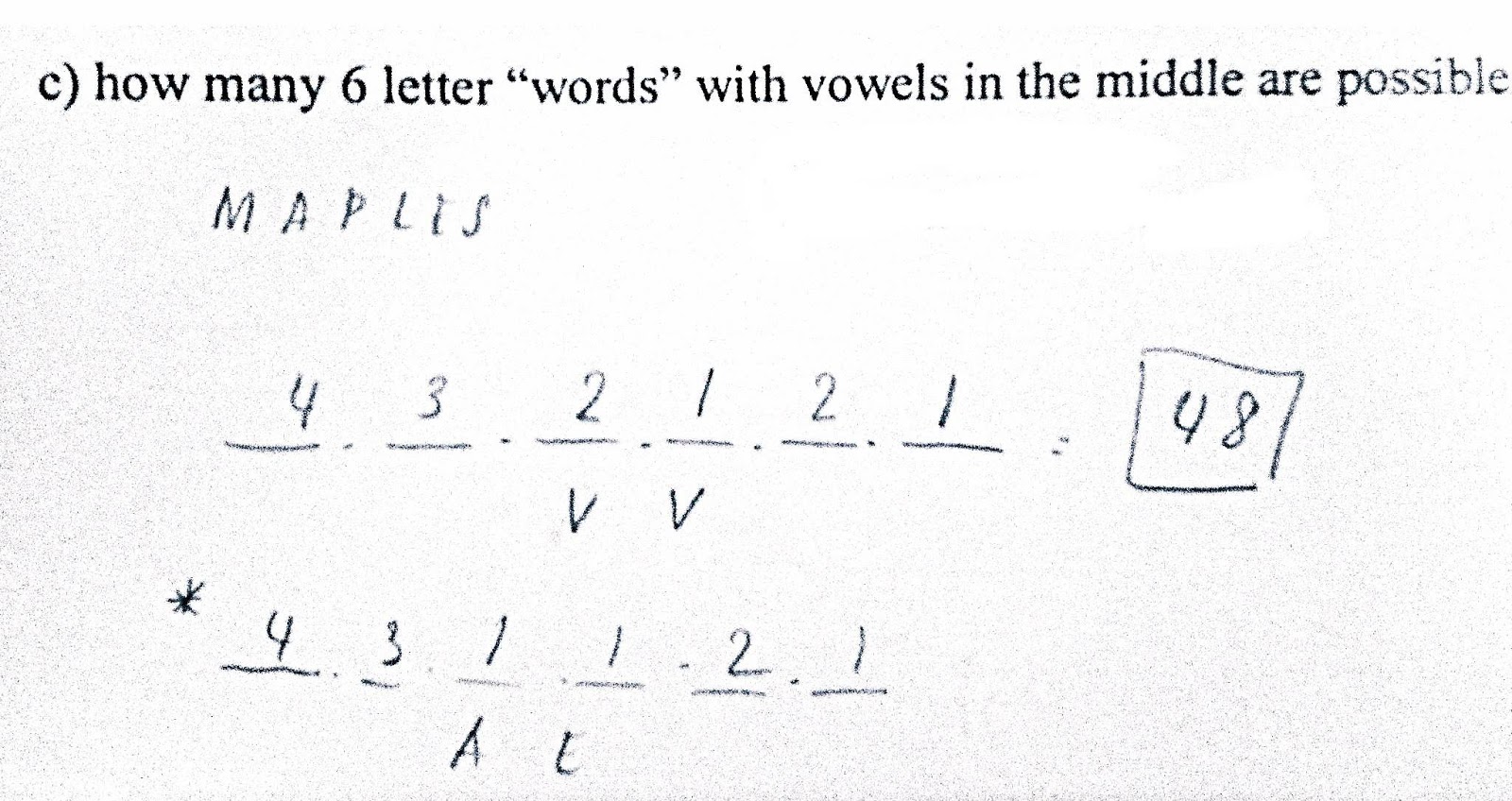
    Such as this one:


     Letter c of example 2 in the handbook seemed a bit like all the other problems we discussed so far, not until someone pointed out an error in the answer. The question stated that the vowels are to be put in the middle but did not specify which position the vowels are to be placed.

   As you can see at the bottom of the picture, a and e are placed beside each other with number 1 placed above each letter. This indicates the total amount of vowels in the word MAPLES, which is two. But since it isn't stated in the question where the vowels are supposed to be placed, a and e are replaced with the letter v, to specify the restriction. 

   And also because of this, without any specification of any position for both of the vowels, and because the total number of vowels is two, the number two is placed above the first v while the number 1 is placed above the second v. Since the first vowel took one of the two positions in the middle, where both vowels should be placed, the second vowel takes the second place. And the rest of the spaces are filled with whatever number of letters are left.

    So all in all, that's it. I tried my hardest and best to sound smart and cover most of the stuff we learned today in class. I hope i did well in both and good luck to all of you. 

:)
   

Monday, September 9, 2013

Fundamental Counting and Introduction to Factorial Notation


      Hi, my name is Nurielle Gregorio and I'll recap the two lessons we learned today. First of all, the morning portion of precal class, started with Mr. Piatek introducing us with a brief tour of our class website, which he worked on over the weekend. As you may all know, the website is a very useful tool that can potentially help everyone with any math problems, and even just as a study guide.

      Afterwards, most of the morning class was based on expanding our knowledge with The Fundamental Counting Principle. Once again, we opened our precal unit 1 handbook, titled as Permutations, Combinations, and Binomial Theorem. There, we were introduced with some basic rules of Fundamental Counting.

    As you can see, the image states the keywords we should look for when solving Fundamental Counting problems. In brief:

 Keywords:

"AND", "BOTH"
= multiplication

"OR", "EITHER", "OPPOSITE" = addition


 We continued to work on some more problems, and we encountered on a problem that is based on both of the principles of Fundamental Counting. 

   Example 5: Suppose that the executive of the Manitoba Association of Mathematics Teachers consists of three woman and two men. In how many ways can a president and a secretary be chosen if: 

 a.) The president is to be female and the     secretary male? 

 Step 1: Knowing that the problem stated "and", therefore, we should use multiplication. Also because they are asking for two different groups, female AND male.
Step 2: Find the number of females and male, which in this case, there are 3 females, and 2 males.
Therefore, it should be written as
3/president female x 2/secretary male= 6

b.) The president is to be male and the secretary female?

The answer should not be differ from a.) because your are still multiplying male with female. However, it is written differently, now that male is to be president, and female to be secretary:
2/president male x 3/secretary female=6

c.) The president and secretary are to be of the opposite sex?

    Step 1: Going back to the keywords/rules shown earlier, it is stated that "OPPOSITE"= ADD. So, 6+6= 12


Factorial Notation 

The second part of precal, which was in the afternoon, included our second lesson called
FACTORIAL NOTATION. 
The symbol for factorial is an exclamation mark (!)


 I found a video that helped me understand the concept of factorial notation more. However, the video included addition questions which we did not learn yet, but other than that, the video is very clear and helpful!


More complex factorial questions
Throughout the class, we worked on more complex questions.

For these questions, your must really understand that n!= n(n-1)(n-2)...(3)(2)(1), where n is the component of the positive integers.

Examples e. and d. are both very straight forward, as long as you take in mind the numbers you can cancel. So, if the numerator and the denominator have the same number, they can cancel out. 


Example e.) (s-2)!/ (s+1)!

Step 1: Knowing the equation n!= n(n-1)(n-2)... we can tell that (s-2) cannot end up to be (s=1) because -2-1=-3.
Step 2: We now try (s+1)!, which actually works. 1-1=0 which is (s), 0-1= -1 which is (s-1). Therefore, -1-1=-2 which is (s-2)
Step 3: Now that we know (s-2)/(s+1)(s)(s-1)(s-2), we end up with (s-2) as numerator, and another (s-2) in the denominator, which we know cancels out.
step 4: Now that they have canceled out each other, we have to take note that the numerator is not 0 but 1, so we are left with 1/(s+1)(s)(s-1).

The last question we worked on in  class will most likely be on the provincial exam! It is also very straight forward but includes factoring.

Exam Question

Example 6: Solve: n(n-5)!= 24(n-6) 

Step 1: Knowing (n-6) cannot be (n-5), we take -5-1= -6 which is (n-6).

Step 2: Now, we see similarity between both sides which is (n-6). Therefore we can divide both side with (n-6) to cancel out. We are then left with n(n-5)=24 

Step 3: You then just move over 24 to the other side, which leaves us with n(n-5)-24=0 

Step 4: FACTOR!
*NOTE* the final answer is n=8, not both n=8 AND n=-3 because in most cases, like this one, a neg number would be an extraneous solution/root.


  To conclude, I believe I've covered most of the concept and problems we encountered today for class. It seems that I wrote a whole unit! Nevertheless, I hope I was able to help, and provide a nice summary and step by step of  what we learned!:)

                                                                                                                   -Nurielle Gregorio


Sunday, September 8, 2013

Introductions and Reintroductions

Hello everyone! I'm Kyle (Sarte) and I'm here to summarize for you what was covered during our first two days of Pre-Calculus 40S. This first blog post is going to be a relatively easy one to write, since more time was spent solving riddles, watching videos, and learning about Mr. Piatek's love for travelling, photography, and mushrooms than on math!

On Thursday afternoon, we went around the class and introduced ourselves by name, accompanied by something interesting about us. We found ourselves amongst artists, musicians, and athletes, and learned of each other's various hobbies and interests. 

Prerequisite Skills worksheet
Following the handing out of our course outline, Mr. Piatek brought us face-to-face with the challenges of Pre-Calculus 40S and the reality of what was to be expected. He emphasized that Pre-Calculus 40S is the "class you have never taken before in high school", but also reminded us (using two past students as examples) that a final mark of 100 is an achievable score. Points about the provincial exam at the end of the semester were also brought up, with Mr. Piatek mentioning it's 30% weight on our final mark (as opposed to the previous year's 5%) and the test's format.

While the Monkey Business Illusion (which you can watch again by clicking here) was a great lesson in observation and Mr. Piatek succeeded in messing with our minds with his math magic trick, a fair bit of Friday's class was spent reintroducing ourselves to grade 11 pre-calculus topics  with the Prerequisite Skills worksheet (pictured left). 


Some problems on the worksheet included factoring, producing and sketching graphs, solving trigonometric equations, determining the reference angle, and completing the square. In class, the one example Mr. Piatek went over with us was the factoring of a cubic polynomial. To reiterate what he covered in class, I have provided a mini-lesson write up for anyone needing a reminder.


For the last half hour to forty-five minutes of class, we began on our first unit booklet entitled Permutations, Combinations, and Binomial Theorem.

The Fundamental Counting Principle
Example 1: A cafe has a lunch special consisting of an egg or a ham sandwich (E,H); milk, juice, or coffee (M,J,C); and a yogurt or pie (Y,P) for dessert. List all possible meals if one item is taken from each category. How many meals are there? 
By using a graphical method of listing out each letter and the possible meal choices, a total of 12 choices were calculated. This method allowed for a detailed visual representation of the meal possibilities, but was a very time consuming effort.
How could you determine this without listing them?
Simply multiplying the amounts of exclusive choices (2 sandwich choices, 3 drink choices, and 2 dessert choices) yielded the same results in less time.


Reaching no further than the first page, Mr. Piatek spoke a bit more on the fundamental counting principle and ended the lesson there.

Hopefully my summary of our first two days in class got across clearly. I feel as if I've written too much, so I'll end this here. I look forward to learning and studying with all of you this semester!

Thanks for reading, 

Kyle Sarte

Tuesday, August 27, 2013

Welcome Back Grade 12 Students

Welcome to our blog. This space is designed for students of Maples Collegiate, attending Pre-Calculus 40S class with Mr.P. We are going to use this space to discuss our daily lessons, ask questions you didn't get a chance to ask in class, and to share your knowledge with other students. Most importantly we will use this blog to reflect on what we're learning.
Have a great semester.